What you can practise
- Two exercises
- Parallel and reverse bay parking share the same controls.
- Three space sizes
- Wide, standard and tight spaces change the challenge.
- Local results
- Completed attempts are saved in this browser when local storage works. Clearing site data removes that history.
How to use this practice
Choose your space
Start with reverse bay or parallel parking and a wide space. Try standard or tight spaces after learning the controls. Changing the exercise or difficulty starts a fresh attempt. Both exercises begin in reverse.
Learn the controls
Left and right arrows, or A and D, steer. Up or W accelerates; down, S or the space bar brakes. On-screen buttons support touch. The up arrow adds power; it does not select forward gear.
Make a controlled correction
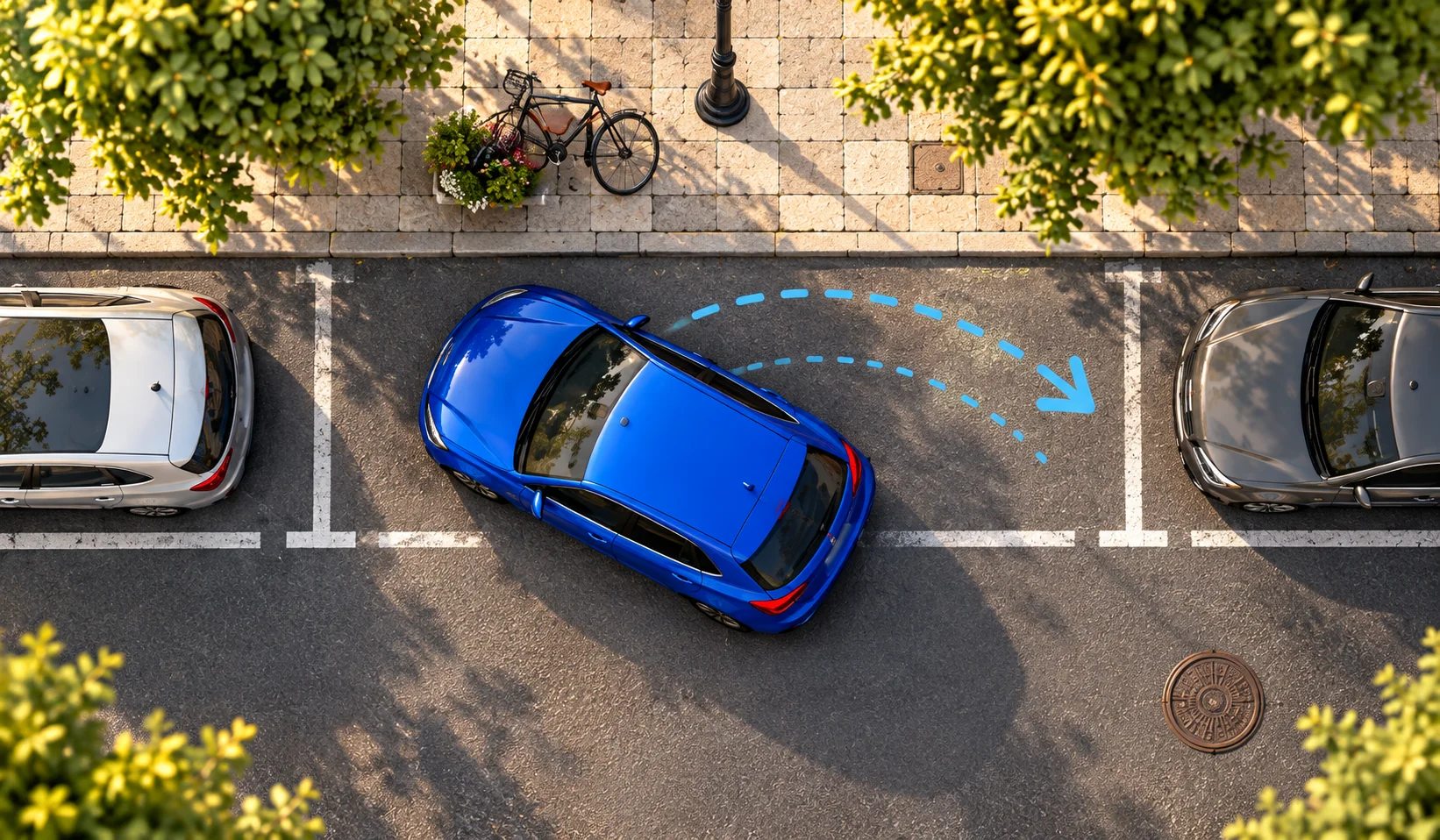
Stop fully, then press R or the direction button to switch between reverse and drive. Watch the front corner as well as the rear. Use the path guide or demonstration to inspect the approach. A demonstration resets your attempt when it ends.
Finish and review
Bring the entire car inside the marked space, straighten it, stop and select P. Review your time, contacts and alignment. Retry with one change, such as less speed or an earlier correction.
Questions before you start
Will this teach me to park a real car?
It explores positioning in a simplified simulation. It cannot reproduce real visibility, controls or handling and does not replace instruction. Do not transfer screen reference points directly to a vehicle.
Can I use my phone?
Touch controls and a 2D canvas are provided; a keyboard also works. Performance can vary by device and browser.
What do the points mean?
Contacts, extra direction changes and a long completion time can reduce this exercise’s score. It is not an official test result or a measure of driving fitness.